print(os.environ.get('CUDA_PATH'))/usr/lib/cudadifferent type of
unet modelfrom tversky focal loss paper will be implemented here
print(os.environ.get('CUDA_PATH'))/usr/lib/cudapooling (inputs, max_pool_only=False, both=True, pool_size=2)
 conv_block (inputs, filter_no, kernel_size, batch_nm=True, dropout=True,
             drp_rt=0.1, kernel_initializer='glorot_normal')
Create a conv block with batch norma and dropout
| Type | Default | Details | |
|---|---|---|---|
| inputs | |||
| filter_no | |||
| kernel_size | |||
| batch_nm | bool | True | |
| dropout | bool | True | |
| drp_rt | float | 0.1 | |
| kernel_initializer | str | glorot_normal | option he_normal |
input_size = tf.random.normal((1, 1152, 1632, 1))
out_ = conv_block(input_size, 32, 3, batch_nm=False, dropout=False)
test_eq([1,1152, 1632, 32], out_.shape)double_conv (inputs, filter_no, kernel_size, batch_nm=True, dropout=True, drp_rt=0.1, kernel_initializer='glorot_normal')
Create double conv block with batch norma and dropout
| Type | Default | Details | |
|---|---|---|---|
| inputs | |||
| filter_no | |||
| kernel_size | |||
| batch_nm | bool | True | |
| dropout | bool | True | |
| drp_rt | float | 0.1 | |
| kernel_initializer | str | glorot_normal | option he_normal |
out_c = double_conv(inputs=input_size, filter_no=32, kernel_size=3, batch_nm=True, dropout=True, drp_rt=0.1)
out_p = pooling(out_c, both=True)test_eq([1,1152, 1632, 32], out_c.shape)
test_eq([1,576, 816, 64], out_p.shape)h, w, c = 1152, 1632, 1encoder_block (input_size:tensorflow.python.framework.tensor.Tensor, filter_size:List[int]=[16, 32, 64, 128, 256], kernel_initializer:str='glorot_normal')
Create Encoder block for Unet
| Type | Default | Details | |
|---|---|---|---|
| input_size | Tensor | ||
| filter_size | typing.List[int] | [16, 32, 64, 128, 256] | |
| kernel_initializer | str | glorot_normal | option he_normal |
#h, w, c = 1052, 1632, 1
#h, w, c = 1152, 1632, 1
input_img = tf.random.normal((1, h, w, c))
inputs,enc_outputs, final_l = encoder_block(
    input_size=(h, w, c),
    filter_size=[16,32,64,128],
    kernel_initializer='glorot_normal' #option he_normal
)enc_outputs[<KerasTensor: shape=(None, 1152, 1632, 16) dtype=float32 (created by layer 'dropout_16')>,
<KerasTensor: shape=(None, 576, 816, 32) dtype=float32 (created by layer 'dropout_18')>,
<KerasTensor: shape=(None, 288, 408, 64) dtype=float32 (created by layer 'dropout_20')>,
<KerasTensor: shape=(None, 144, 204, 128) dtype=float32 (created by layer 'dropout_22')>]final_l<KerasTensor: shape=(None, 72, 102, 256) dtype=float32 (created by layer 'dropout_24')>test_eq((None, 1152, 1632, 1), inputs.shape)expected_shapes = [
(None, 1152, 1632, 16),
(None, 576, 816, 32),
(None, 288, 408, 64),
(None, 144, 204, 128),
]
for (expected, actual) in zip(expected_shapes, enc_outputs):
test_eq(expected, actual.shape)len(enc_outputs)4crop_and_concat (upsampled:tensorflow.python.framework.tensor.Tensor, skip_connection:tensorflow.python.framework.tensor.Tenso r)
Crop or pad the skip connection and concatenate it with the upsampled tensor. Args: - upsampled (tf.Tensor): Tensor from the decoder path. - skip_connection (tf.Tensor): Corresponding tensor from the encoder path. Returns: - tf.Tensor: Tensor after cropping or padding and concatenation.
skip_connection = tf.random.normal([1, 16, 16, 128])  # Simulating a feature map from the encoder
upsampled = tf.random.normal([1, 14, 14, 128])
crop_concat_image = crop_and_concat(upsampled, skip_connection)
test_eq(crop_concat_image.shape, [1, 14, 14, 256])
Cropping branchdecoder_block (filter_list:List[int], encoder_outputs:List[tensorflow.python.framework.tensor.Te nsor], bottleneck:tensorflow.python.framework.tensor.Tensor)
Create a decoder block for unet
inputs,enc_outputs, final_l = encoder_block(
    input_size=(h, w, c),
    filter_size=[16,32,64,128],
    kernel_initializer='glorot_normal' #option he_normal
    )
out_, dec_out_list = decoder_block(
    filter_list=[16,32,64,128],
    encoder_outputs=enc_outputs,
    bottleneck=final_l,
    )
expected_decoder_shapes = [
(None, 144, 204, 256),
(None, 288, 408, 128),
(None, 576, 816, 64),
(None, 1152, 1632, 32),
]
for (expected, actual) in zip(expected_decoder_shapes, dec_out_list):
test_eq(expected, actual.shape)
test_eq((None, 1152, 1632, 16), out_.shape)unet_model (input_size:Tuple[int]=(1152, 1632, 1), filter_list:List[int]=[16, 32, 64, 128], kernel_initializer:str='glorot_normal', n_classes:int=1)
Create a unet model
| Type | Default | Details | |
|---|---|---|---|
| input_size | typing.Tuple[int] | (1152, 1632, 1) | |
| filter_list | typing.List[int] | [16, 32, 64, 128] | |
| kernel_initializer | str | glorot_normal | option he_normal |
| n_classes | int | 1 |
model_ = unet_model(
    input_size=(1152, 1632, 1),
    filter_list=[16,32,64,128],
    n_classes=1,
    )
tf.keras.utils.plot_model(model_, show_shapes=True, show_layer_activations=True)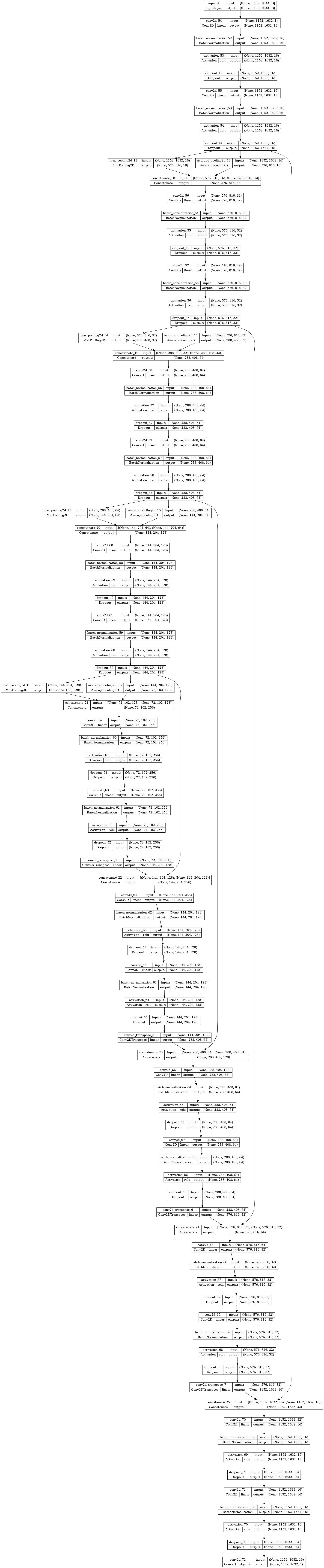
 unet_gating_signal (input:tensorflow.python.framework.tensor.Tensor,
                     out_size:int, is_batchnorm:bool, name:str,
                     kinit:str='glorot_normal')
this is simply 1x1 convolution, bn, activation
expend_as (tensor, rep, name)
attention_blocks (x, g, inter_shape, name)
take g which is the spatially smaller signal, do a conv to get the same number of feature channels as x (bigger spatially) do a conv on x to also get same feature channels (theta_x) then, upsample g to be same size as x add x and g (concat_xg) relu, 1x1 conv, then sigmoid then upsample the final - this gives us attn coefficients
 decoder_block_attention_gates (filter_list:List[int],
                                encoder_outputs:List[tensorflow.python.fra
                                mework.tensor.Tensor], bottleneck:tensorfl
                                ow.python.framework.tensor.Tensor)
Create a decoder block for unet with attention gates
inputs, encoder_output, bottle_neck_enc = encoder_block(
    input_size=(256, 256,1),
    filter_size=[64,128,256,512],
    )
dec_final, decoder_outputs = decoder_block_attention_gates(
    filter_list=[64,128,256,512],
    encoder_outputs=encoder_output,
    bottleneck=bottle_neck_enc,
    )
testing decoder output shape
expected_attn_deocder_shapes = [
    (None, 32, 32, 512),
    (None, 64, 64, 256),
    (None, 128, 128, 128),
    (None, 256, 256, 64),
]
for (expected, actual) in zip(expected_attn_deocder_shapes, decoder_outputs):
test_eq(expected, actual.shape)unet_model_attention_gates (input_size:Tuple[int]=(256, 256, 1), filter_list:List[int]=[64, 128, 256, 512], kernel_initializer:str='glorot_normal', n_classes:int=1)
Create a unet model
| Type | Default | Details | |
|---|---|---|---|
| input_size | typing.Tuple[int] | (256, 256, 1) | |
| filter_list | typing.List[int] | [64, 128, 256, 512] | |
| kernel_initializer | str | glorot_normal | option he_normal |
| n_classes | int | 1 |
attn_unet_model_ =unet_model_attention_gates(
    input_size=(256, 256, 1),
    filter_list=[64,128,256,512],
    n_classes=1,
    )
tf.keras.utils.plot_model(attn_unet_model_, show_shapes=True, show_layer_activations=True)
 res_double_conv (inputs, filter_no, kernel_size, batch_nm=True,
                  dropout=True, drp_rt=0.1,
                  kernel_initializer='glorot_normal')
Create double conv block with batch norma and dropout
| Type | Default | Details | |
|---|---|---|---|
| inputs | |||
| filter_no | |||
| kernel_size | |||
| batch_nm | bool | True | |
| dropout | bool | True | |
| drp_rt | float | 0.1 | |
| kernel_initializer | str | glorot_normal | option he_normal |
 residual_encoder_block
                         (input_size:tensorflow.python.framework.tensor.Te
                         nsor, filter_size:List[int]=[16, 32, 64, 128,
                         256], kernel_initializer:str='glorot_normal')
Create Encoder block for residual Unet
| Type | Default | Details | |
|---|---|---|---|
| input_size | Tensor | ||
| filter_size | typing.List[int] | [16, 32, 64, 128, 256] | |
| kernel_initializer | str | glorot_normal | option he_normal |
 residual_decoder_block (filter_list:List[int],
                         encoder_outputs:List[tensorflow.python.framework.
                         tensor.Tensor], bottleneck:tensorflow.python.fram
                         ework.tensor.Tensor)
Create a decoder block for unet with attention gates
 residual_attn_unet (input_size:Tuple[int]=(256, 256, 1),
                     filter_list:List[int]=[64, 128, 256, 512],
                     kernel_initializer:str='glorot_normal',
                     n_classes:int=1)
Create a residual attention unet model
| Type | Default | Details | |
|---|---|---|---|
| input_size | typing.Tuple[int] | (256, 256, 1) | |
| filter_list | typing.List[int] | [64, 128, 256, 512] | |
| kernel_initializer | str | glorot_normal | option he_normal |
| n_classes | int | 1 |
resdual_attn_unet = residual_attn_unet(
    input_size=(256, 256, 1),
    filter_list=[64,128,256,512],
    n_classes=1,
    )
tf.keras.utils.plot_model(resdual_attn_unet, show_shapes=True, show_layer_activations=True)
from tensorflow.keras import layersdef res_conv_block(x, filter_size, size, dropout, batch_norm=False):
'''
Residual convolutional layer.
Two variants....
Either put activation function before the addition with shortcut
or after the addition (which would be as proposed in the original resNet).
1. conv - BN - Activation - conv - BN - Activation
- shortcut - BN - shortcut+BN
2. conv - BN - Activation - conv - BN
- shortcut - BN - shortcut+BN - Activation
Check fig 4 in https://arxiv.org/ftp/arxiv/papers/1802/1802.06955.pdf
'''
conv = layers.Conv2D(size, (filter_size, filter_size), padding='same')(x)
if batch_norm is True:
conv = layers.BatchNormalization(axis=3)(conv)
conv = layers.Activation('relu')(conv)
conv = layers.Conv2D(size, (filter_size, filter_size), padding='same')(conv)
if batch_norm is True:
conv = layers.BatchNormalization(axis=3)(conv)
#conv = layers.Activation('relu')(conv) #Activation before addition with shortcut
if dropout > 0:
conv = layers.Dropout(dropout)(conv)
shortcut = layers.Conv2D(size, kernel_size=(1, 1), padding='same')(x)
if batch_norm is True:
shortcut = layers.BatchNormalization(axis=3)(shortcut)
res_path = layers.add([shortcut, conv])
res_path = layers.Activation('relu')(res_path) #Activation after addition with shortcut (Original residual block)
return res_path
def gating_signal(input, out_size, batch_norm=False):
"""
resize the down layer feature map into the same dimension as the up layer feature map
using 1x1 conv
:return: the gating feature map with the same dimension of the up layer feature map
"""
x = layers.Conv2D(out_size, (1, 1), padding='same')(input)
if batch_norm:
x = layers.BatchNormalization()(x)
x = layers.Activation('relu')(x)
return x
def attention_block(x, gating, inter_shape):
shape_x = K.int_shape(x)
shape_g = K.int_shape(gating)
# Getting the x signal to the same shape as the gating signal
theta_x = layers.Conv2D(inter_shape, (2, 2), strides=(2, 2), padding='same')(x) # 16
shape_theta_x = K.int_shape(theta_x)
# Getting the gating signal to the same number of filters as the inter_shape
phi_g = layers.Conv2D(inter_shape, (1, 1), padding='same')(gating)
upsample_g = layers.Conv2DTranspose(inter_shape, (3, 3),
strides=(shape_theta_x[1] // shape_g[1], shape_theta_x[2] // shape_g[2]),
padding='same')(phi_g) # 16
concat_xg = layers.add([upsample_g, theta_x])
act_xg = layers.Activation('relu')(concat_xg)
psi = layers.Conv2D(1, (1, 1), padding='same')(act_xg)
sigmoid_xg = layers.Activation('sigmoid')(psi)
shape_sigmoid = K.int_shape(sigmoid_xg)
upsample_psi = layers.UpSampling2D(size=(shape_x[1] // shape_sigmoid[1], shape_x[2] // shape_sigmoid[2]))(sigmoid_xg) # 32
upsample_psi = repeat_elem(upsample_psi, shape_x[3])
y = layers.multiply([upsample_psi, x])
result = layers.Conv2D(shape_x[3], (1, 1), padding='same')(y)
result_bn = layers.BatchNormalization()(result)
return result_bn
def repeat_elem(tensor, rep):
# lambda function to repeat Repeats the elements of a tensor along an axis
#by a factor of rep.
# If tensor has shape (None, 256,256,3), lambda will return a tensor of shape
#(None, 256,256,6), if specified axis=3 and rep=2.
return layers.Lambda(lambda x, repnum: K.repeat_elements(x, repnum, axis=3),
arguments={'repnum': rep})(tensor)
def Attention_ResUNet(input_shape, NUM_CLASSES=1, dropout_rate=0.0, batch_norm=True):
'''
Rsidual UNet, with attention
'''
# network structure
FILTER_NUM = 64 # number of basic filters for the first layer
FILTER_SIZE = 3 # size of the convolutional filter
UP_SAMP_SIZE = 2 # size of upsampling filters
# input data
# dimension of the image depth
inputs = layers.Input(input_shape, dtype=tf.float32)
axis = 3
# Downsampling layers
# DownRes 1, double residual convolution + pooling
conv_128 = res_conv_block(inputs, FILTER_SIZE, FILTER_NUM, dropout_rate, batch_norm)
pool_64 = layers.MaxPooling2D(pool_size=(2,2))(conv_128)
# DownRes 2
conv_64 = res_conv_block(pool_64, FILTER_SIZE, 2*FILTER_NUM, dropout_rate, batch_norm)
pool_32 = layers.MaxPooling2D(pool_size=(2,2))(conv_64)
# DownRes 3
conv_32 = res_conv_block(pool_32, FILTER_SIZE, 4*FILTER_NUM, dropout_rate, batch_norm)
pool_16 = layers.MaxPooling2D(pool_size=(2,2))(conv_32)
# DownRes 4
conv_16 = res_conv_block(pool_16, FILTER_SIZE, 8*FILTER_NUM, dropout_rate, batch_norm)
pool_8 = layers.MaxPooling2D(pool_size=(2,2))(conv_16)
# DownRes 5, convolution only
conv_8 = res_conv_block(pool_8, FILTER_SIZE, 16*FILTER_NUM, dropout_rate, batch_norm)
# Upsampling layers
# UpRes 6, attention gated concatenation + upsampling + double residual convolution
gating_16 = gating_signal(conv_8, 8*FILTER_NUM, batch_norm)
att_16 = attention_block(conv_16, gating_16, 8*FILTER_NUM)
up_16 = layers.UpSampling2D(size=(UP_SAMP_SIZE, UP_SAMP_SIZE), data_format="channels_last")(conv_8)
up_16 = layers.concatenate([up_16, att_16], axis=axis)
up_conv_16 = res_conv_block(up_16, FILTER_SIZE, 8*FILTER_NUM, dropout_rate, batch_norm)
# UpRes 7
gating_32 = gating_signal(up_conv_16, 4*FILTER_NUM, batch_norm)
att_32 = attention_block(conv_32, gating_32, 4*FILTER_NUM)
up_32 = layers.UpSampling2D(size=(UP_SAMP_SIZE, UP_SAMP_SIZE), data_format="channels_last")(up_conv_16)
up_32 = layers.concatenate([up_32, att_32], axis=axis)
up_conv_32 = res_conv_block(up_32, FILTER_SIZE, 4*FILTER_NUM, dropout_rate, batch_norm)
# UpRes 8
gating_64 = gating_signal(up_conv_32, 2*FILTER_NUM, batch_norm)
att_64 = attention_block(conv_64, gating_64, 2*FILTER_NUM)
up_64 = layers.UpSampling2D(size=(UP_SAMP_SIZE, UP_SAMP_SIZE), data_format="channels_last")(up_conv_32)
up_64 = layers.concatenate([up_64, att_64], axis=axis)
up_conv_64 = res_conv_block(up_64, FILTER_SIZE, 2*FILTER_NUM, dropout_rate, batch_norm)
# UpRes 9
gating_128 = gating_signal(up_conv_64, FILTER_NUM, batch_norm)
att_128 = attention_block(conv_128, gating_128, FILTER_NUM)
up_128 = layers.UpSampling2D(size=(UP_SAMP_SIZE, UP_SAMP_SIZE), data_format="channels_last")(up_conv_64)
up_128 = layers.concatenate([up_128, att_128], axis=axis)
up_conv_128 = res_conv_block(up_128, FILTER_SIZE, FILTER_NUM, dropout_rate, batch_norm)
# 1*1 convolutional layers
conv_final = layers.Conv2D(NUM_CLASSES, kernel_size=(1,1))(up_conv_128)
conv_final = layers.BatchNormalization(axis=axis)(conv_final)
conv_final = layers.Activation('sigmoid')(conv_final) #Change to softmax for multichannel
# Model integration
model = tf.keras.models.Model(inputs, conv_final, name="AttentionResUNet")
return model
input_shape = (256, 256, 1)
attn_res_unet_ = Attention_ResUNet(input_shape, NUM_CLASSES=1, dropout_rate=0.0, batch_norm=True)
tf.keras.utils.plot_model(attn_res_unet_, show_shapes=True, show_layer_activations=True)